Squares and Circles: manual random travel encounters
Here's a little bit of musing based on a chat I had in the pub last night about the Sorcery! video game adaptations.
Sorcery!, if you think about it, is a classic pointcrawl (and also the best fantasy adventure that has ever existed in any format). It also doesn't really have random encounters. It has encounters that happen at a given place on the road, and encounters that happen at a specific point in time, but nothing random. Several actual pen-and-paper roleplaying games have done stuff like this before! In lots of whatever-crawls (including my own) there are plenty of specifically located 'fills' that are just stumbling across a random traveller or beast or treasure that are themselves described as actively travelling but are 'frozen in place' until you arrive. I think this is a perfectly fine and good way to do things.
'Fully' random encounters are difficult. They can often feel quite nebulous and unspecific unless you go quite granular by making tables for each specific neighbourhood filled with the specific people who are hanging out in that given area.
Wolves has a great solution to this. It has one big table for each kingdom or island, with very few 'no encounter' results. You never 'check' to see if you roll on the table. You always just roll on it twice a day (meaning it has nothing to do with the hex-grid). The clever thing about it? Half of the results are "if you are within 1/2/3 hexes of xxx-xxx, encounter this specific freak, otherwise no encounter". It's so clever. Good job Big Dog.
But what if you went a step further though? When I ran Wolves, I made my own map of Albann and did away with the hex format entirely - instead I just eye-balled distances. Have a look at it (squint your eyes if you don't want spoilers):
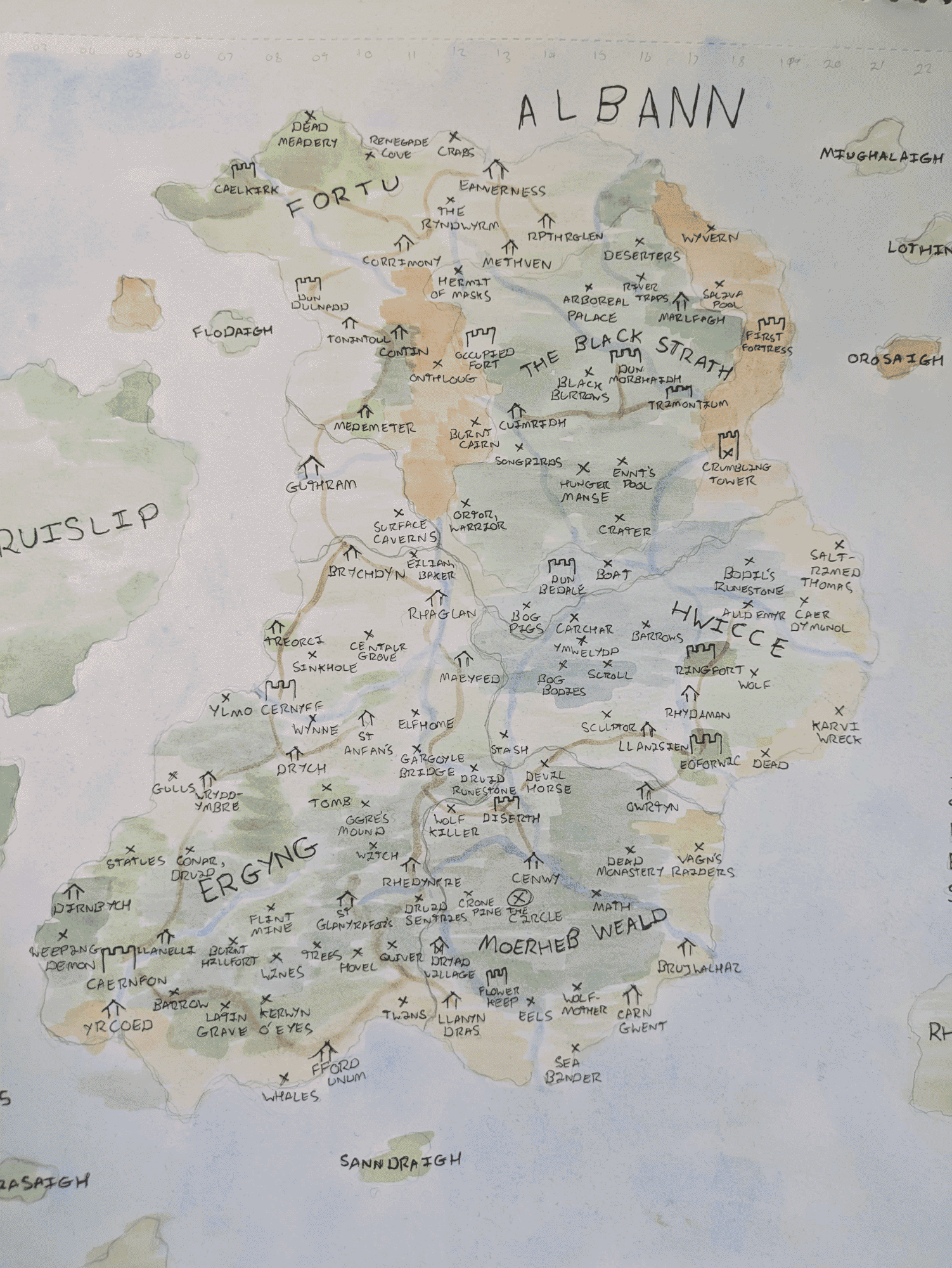
Pretty map right? Anyway. Here's the point. During my games, I adjudicated random encounters as following: whenever the players were outside a settlement, I would roll on the relevant random encounter table at midday, and then if they were camping in the wilderness or they arrived at a village late on, I would roll again.
It was always very satisfiying to roll those 'if within 3 hexes' local encounters on the table: they took no effort as GM to make sense of and fit into the narrative. The experience got me thinking: what if, instead of rolling on a big table, I just made the choice 'manually' based on what locations were nearby and made sense to be roaming around. Let's do an example:
Let's say I look at the map and see that the characters are in the Moerheb Weald, north of the river. I can consider the different encounters that might show up based on nearby hexes:
- Folks from the nearby village hunting (or a pig that's ran off)
- Some of the northern raiders from the nearby camp hunting or logging.
- The monster from the nearby ruins (if agitated)
- The nearby hermit, doing some herb-gathering
- Or the freaky horse.
And perhaps, if I'm focusing on them in the campaign (or want to introduce them), I might also want to consider some of the factions who might be there:
- Some of the blokes who claim ownership of this place beating the bounds
- Bandits (perhaps partisans exiled from the neighbouring kingdom)
This is super easy to do, because all I need to do is look at the points on the map that are nearby to where the characters are!
Having done this, I can just choose who I'd like for them to encounter at that time entirely based on what I think would be most interesting. I can have them encounter two at once if it comes to mind, or their corpses or a battle between them or so on. It's easy! I honestly think that by stripping out procedure it's actually easier and simpler to run. There are lots of things that it's easy to do as a human but hard for a 'computer' (a table or procedure or so on is just a computer) to do. This seems like one of those cases.
If you're a dice pervert and feel the need for it to be somewhat random, you could also just roll a d6 for each of them and have them show up on a 1 (or higher if they're particularly present). Or you could roll a d6 where each value corresponds to a different encounter on the 'table' that you arbitrate in your head in the moment.
Once again, this is as easy as looking at the things on the map. The reason this 'manual' method works for me is because I've drawn a nice big A3 map and actually written on the name of each location for easy reference, instead of just using symbols. You don't need to use the table if you've done this (but get this: you still could if you want).
This 'manual' method is the main idea that I'm suggesting here. However, you might be wondering why the title that I've posted this under is 'Squares and Circles'. That's because it was a neat idea we came up with in the pub. It goes as follows:
- Draw your map's topography.
- When adding locations, signify them with their name and then either a little Square or a little Circle showing their precise location.
- The square signifies a location that is 'in a box'. It doesn't host characters who roam beyond it. Examples would be a sealed dungeon or an isolated runestone.
- The circle signifies a location with an 'area of effect', where elements from that place leak out into the surrounding radius. Examples would be the lair of a monster that stalks around, or the off-the-road camp of some highwaymen, or a city.
- And that's all!
You don't even need to literally have the circle be the 'area of effect': it could just be a little dot. And if you really wanted to stress that it's a wide expanse where the location might manifest itself, you could have it be two concentric circles! Or three! Like a dragon that flies for dozens of miles all around the region.
Furthermore, you might still come up with and run an encounter related to a 'square' location (like some tomb-robbers going to check out an abandoned dungeon that the characters had been blabbing about).
This method of preparation can ease your improvisation as a GM so much. When you want to do a random encounter, just look at the map and decide something based on what's nearby, as signalled by the Circle locations.
And here's the crazy part: if you want to have something totally different happen? If you want some of the mountain-folks wandering around lost down by the coast? If you want an ambush by an assassin paid by the Satrap that the characters pissed off? You can just do that instead of rolling for a random encounter. You're the GM. You could even - if it makes sense - have jotted them down on the map in advance as a Thing that's There!
To be clear, I'm not necessarily suggesting a 'Squares and Circles' GM reference map is a great way to write a setting from scratch (though it might be?). I'm saying that such a map is a great way to prep for actually running, and might be a better (and prettier) way to invest your time than drawing up encounter tables. It just also requires you to spend a minute prior to each session thinking if you want any out-of-left-field freaks to show up on the road.
This is my mild provocation. Hope it helps someone (beyond me).
Best,
Hags